Saturday, September 6, 2008

Organic Shmorganic

I always get a little thrill when my mom decides to go grocery shopping at Whole Foods, Trader Joe's or New Seasons, knowing that there are so many more options and bigger selection than our local Hank's Thriftway. I'm also filled with an inch of pride knowing that we're choosing to buy "organic" food that is healthier and better for the environment. But is it really?
 
While reading Omnivore's Dilemma by Michael Pollan, I started to question my pride and my "do good" feelings. Pollan mentions that while organic foods are most likely healthier (or at least healthier than the genetically engineered so-called food, which will be discussed in a future post) they aren't always necessarily better for the environment. In most cases organic foods are delivered the same way industrial farm foods are, and therefore use the same amount of fossil fuels. They also may be labeled as organic, free range etc. but as Pollan explains, you can't really tell unless you're actually at the farm/packaging plant. Basically he's saying you can't always trust what the label tells you, which throws my pride right out the window. 

So local foods are better? Maybe so, but they're also more expensive, harder to come by and aren't necessarily pesticide-free. It seems to me that there's no perfect option, you have to take the good with the bad. You can buy from your chain supermarket for cheap prices but with food that's sprayed with pesticides and imported; you can buy from your local farmer's market to become more sustainable but with high prices; you can buy from Whole Food's to get "organic" food but pay sky-high prices; or you can grow some of your own food but lose the convenience factor. I want to feel good about where my food is coming from and the price I'm paying for it, but there doesn't seem to be a clear winner, so I suppose I'll continue doing a mixture of all of them until one clearly becomes more advantageous all around. 

I've always had the notion that products from Whole Foods and the like, were just plain better than anything that I could get at my local supermarket. Omnivore's Dilemma is showing me just how wrong I was. However, I don't think I'm ready give up the feeling I get from shopping at Whole Foods just yet.

Friday, September 5, 2008

An Apple a Day...Brings the Doctor Running?


When I was younger I remember my parents always reminding me to wash my apple before I ate it, and of course, I did....most of the time. At seven years old the only thing your thinking about is getting that juicy apple into your mouth fast enough, the last thing on your mind is pesticides and especially, whether or not that piece of fruit was genetically engineered. 

After watching The Future of Food, I was genuinely scared that I might get cancer or some sort of disease from having eaten so many pesticides and so much genetically modified food through the years. As the first GM foods were introduced in the early 1990's, and I was born in 1990, I very likely have been consuming GM foods my entire life. But after the affects of the dramatic music wore off, and I was able to think a little clearer, I decided that I wasn't in any immediate danger (or so I hope), and there are ways to change my habits so that I no longer consume large quantities genetically engineered food. The only problem is--I'm a college student. Which translates to--I'm on a stringent budget. Which also translates to--I can't buy organic/local/pesticide free/non-GM food all the time because I don't have the means to spend $5 on a piece of fruit. So what's a girl (or any college student, really) to do?

Well, eliminating non-GM food is a no-go because there are no laws that require labels to be put on foods that are modified. So it's almost impossible for anyone to eliminate those entirely unless they grow all of their own food. However, organic and local foods are easier to come by (especially in Seattle) so I could start shopping around at farmer's markets to substitute possible GM produce with organic, local produce. But also, just being aware of where you're food comes from can be helpful. Rather than wallowing in ignorance, start to actually read the signs that are labeling your produce--choose the Washington apples over the New Zealand ones. Of course, these practices are mostly only available when the budget allows, but it's the thought that counts (which can eventually turn into change, when the pockets are a little deeper). Hopefully, with time and baby-steps, my habits can change so that (hopefully) I won't encounter some new fatal disease when I'm older. 

I'm very curious to see in the coming years, what kind of effect consuming genetically modified foods have on individual people and our society as a whole. Will my generation have higher cancer rates? Will there be an new unknown disease? Will there be new regulations on GM foods? In any case, will eating a genetically modified apple bring the doctor running instead of keeping him away? I sure hope not.  

Sunday, August 31, 2008

Brownie Points=0


"Epic fail" as my brother would say. That is how I would describe my attempt to make vegan brownies this past weekend. Well, it wasn't quite that tragic. They were perfectly moist, un-burned and relatively tasty, but...they weren't chocolaty enough! In my book, if brownies are not perfectly chocolaty then they don't really count as brownies. However, I did manage to choke some down so they can't have been that bad. 

But why vegan you ask? Why not stick with the good ol' brownie mix? Well partly because I wanted to try something different in the spirit of this class and my goals as stated in my first blog post, and partly because my mother thinks I may be sensitive to dairy products so I'm currently trying out a dairy-free diet.  Also, if I'm being honest, partly because it was 9:00 on a Sunday night and I was craving chocolate. 

So to the grocery store I went.  I needed to get the ingredients quickly if I was going to have fresh baked brownies before I went to bed. However, it should be noted that most normal people would have flour in their kitchen cupboards and wouldn't have to make a separate trip to the grocery store. This further emphasizes my point that my family is as un-baking/un-cooking as you can get. We didn't even notice that we were out of flour.

The main point of this post though, is to explore the various facets of a dairy-free lifestyle. When my mom initially introduced me to the idea, I thought it would be tough cutting out milk, cheese, and yogurt, but I definitely didn't think it would be as tough as it really is--mainly because it's definitely not just cutting out milk, cheese, and yogurt as I had previously thought. It means cutting out all milk-derived proteins and ingredients, (including whey, lactose, casein, sodium lactate) and a laundry list of others. Of course the exclusion of all these ingredients varies case by case, but for my intents and purposes (testing to see if I am in fact sensitive to dairy) it means cutting all of this out, otherwise I won't really know what's causing the problem. It's kind-of an all or nothing situation. While doing research online I was shocked to find out just how many products are off-limits, or at least I came across things that I didn't even have an inkling that there were traces of dairy in them.  

I found quite a few websites that list which foods are okay to consume and which foods are off-limits, which are all pretty obvious. But then there are the mystery items, the ones where you don't know if they are hiding dairy somewhere without looking at the label, which is impossible to do at restaurants. Things like salad dressings, certain breads, chocolate, most desserts, soups, and party dips are all iffy items. But while it's tough to look at the foods you can't eat, you just have to solace yourself by looking at lists of yummy foods you can eat such as sorbet, fruit candies, French bread (albeit with no butter), pasta, and peanut butter. Unfortunately or fortunately, depending on the way you look at it, this is the diet that I'll be following for the next 4-6 weeks. Or until I can go home to get a blood test. Shudder.

Our class discussions on where our food actually comes from and being aware of what's in it was something that kept popping up in my mind while researching this diet. Thinking about where my food comes from and what's in it will no longer be something I occasionally remember to do while scarfing down some unknown meat, it'll be something I'm constantly thinking about even before I decide that I'm hungry, ready to order etc. With time it'll become second-nature. Whether or not that's a good thing, I haven't decided. 


Judging you, Judging me


The above quote from a Japanese Forum Newsletter, I believe accurately expresses the idea of obento. I believe the intentions of obento are well meant, but the resulting process to create a perfect product is a little extreme for my taste. I'm all for the creative and chimerical presentation of food...when it's being served to me. Like at those fancy-schmancy nouveau restaurants (0f which I rarely eat at). But if I'm making food for someone else, I can't say I put forth the same effort. I don't have the patience or the time for that, especially if I'm making it for a preschooler.

I found it fascinating that almost all Japanese mothers would spend so much time on making food for someone who is so young, and who in all honesty, probably wouldn't care what their food looked like if not for the cultural notions impressed upon them. They go to great lengths to make the transition from home to school easier for their child, and in turn both mother and child are judged on their performance (the former on the creativity and presentation, and the latter on the consumption of the entire obento). But from my point of view this seems to serve as a point of stress rather than ease. Of course, the obento serves other purposes such as teaching discipline and cooperation, which I'm sure produce excellent results.

I know that some mothers in our society spend time making bite-sized food for their children to entice them to eat, but they go no where near the lengths of these mothers (at least that i've seen). But we have taken the foundations of obento into our society and adapted them to fit the modern times i.e. lunch boxes etc. Two years ago I read an article in The Oregonian called "A Better Box Lunch" about packing bento-like boxes for children to get them interested in eating. The article presented a more reasonable approach to obento, for the mothers who don't have insane amounts of time and money to spend on their preschoolers.

I always had hot-lunch though, so maybe I'm a bit resentful.

P.S. The above photos are from our obento making project in class. 


Waste Not, Want Not


Our guest speaker in class on Thursday was chock-full of information about how much food we waste on a daily basis, as compared to how many people are still starving, as well as all of the politics and bureaucracy involved in getting food to these starving people. But however interesting it all was, and however lovely his accent was, it still makes me wonder if we didn't waste any food, would there still be starving people? Something tells me the answer is YES. It is almost impossible to eradicate starvation completely. That is not to say we should be careless with our food because our efforts won't help, they most certainly will, they just won't solve the some of the bigger problems. Clearing your plate every night won't give a starving child a meal. Maybe I'm being cynical, but a lot of the problems that face these starving nations are primarily political. We may send aid to Sudan, but that aid may never necessarily reach the intended party. Of course, our efforts do make a difference but I don't think we'll ever be able to minimize starvation globally until there is somewhat of a peacetime. 

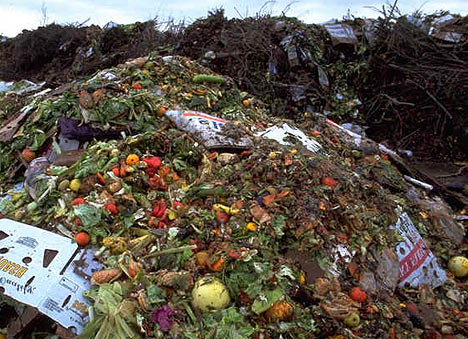
Food waste in America, however, is a whole other story.  American households, on average, waste 14 percent of their food purchases. 15 percent of which is products still within their expiration dates and unopened.  These numbers can be easily decreased by taking simple steps of planning meals, and using up all of the food in the pantry before purchasing more. And while this may help decrease food waste, it doesn't necessarily distribute food to those who need it most. For that we have another set of obstacles to overcome. 

All this talk about food waste also reminded me of  my grandparents, parents and the age-old saying "When I was your age..." adjoined with whatever lesson they preferred to teach at the time. But the particular lesson that came to mind was the one about clearing my plate, and that I should be lucky to have food the table because there are children starving in Africa. Yeah, that one. And while the lecture tended to fill me with a little guilt, it didn't make me want to eat my green beans any more than before the lecture. I simply wasn't hungry, and I wasn't going to eat those slimy green beans unless someone forced them down my throat. In Janet Poppendieck's Want Amid Plenty: From Hunger to Inequality, she discusses this mindset "For American's reared as members of the 'clean plate club' and socialized to associate our own uneaten food with hunger in faraway places, such programs have enormous appeal. They provide some sort of moral relief from the discomfort that ensues when we are confronted with images of hunger in our midst, or when we are reminded of the excesses of consumption that characterize our culture." She goes even deeper into the issue by discussing the relief American's feel knowing there are programs that try to distribute excess food to those in need.  Which leads me to another point, forcing a child to clear their plate doesn't necessarily promote the idea of not wasting food, when that food could be easily packaged and put into the fridge. I feel like now when childhood obesity is on the rise, telling a child that they are full only when their plate is clear is not the best way to encourage healthful eating. According to Private Healthcare UK there are more severely obese people in the world (over one billion) than there are people starving (800,000). There are plenty of other ways to teach a child about not wasting food other than making them eat till they are busting at the seams. 

photo credit: http://www.dailymail.co.uk/new/article-564658/

Tuesday, August 26, 2008

Aspirations

Stirring, baking, peeling, sauteeing, and every other action done in the kitchen besides eating have never really been my style. I have never really had a yearning to season vegetables, braise meat or whip up a fabulous cake. Until now.

No one in my family, not even my wonderful mother, has ever really had a passion, if you will, for anything to do with food (besides consuming it). I have never been known to my friends or family as the one who cooks, bakes or even makes a pitcher of lemonade. When there's a potluck where everyone is supposed to bring a dish, I'm the one who shows up with the bag of chips and hopes no one will notice that I didn't spend hours slaving away in the kitchen over a casserole.

But while casually surfing the web for food blogs last night and simultaneously munching on candy as was the assignment (well not the candy part...), I found myself becoming more intrigued and addicted than I ever would have guessed. An hour and half and half a box of Jujy fruits later I discovered a new desire to hit the farmer's market, combine ingredients and preheat the oven. It's a unfamiliar and strange feeling, wanting to cook and/or bake, but hopefully, with the help of this class it'll stay.

But along with this new desire to cook, also came a curiosity  about every other aspect of food such as, where it comes from, what is in it (as is discussed in our assigned reading All Over Creation, by Ruth Ozeki) , how much is wasted and why, and other cultural facets involving food. 

I have many aspirations for this food blog, thus the obvious title, but mainly it'll be a place for me to document my experiences and learnings on this venture into unknown territory.